


ThruLines is a DC Health data brief series designed to inform the public about ongoing public health challenges. The series aims to take insights gleaned from analysis of local data to inspire evidence-based policies and programs that improve health in the District.
Childhood Immunization Coverage in the District of Columbia
Childhood Immunization Coverage in the District of ColumbiaOutbreaks of measles are occurring in several states, and in recent years pertussis (whooping cough) has resurged in the U.S., putting children at serious risk. Vaccines are the best defense against these and many other infectious diseases. Vaccines protect both the children who are vaccinated and others around them.
Preventing epidemics of vaccine-preventable diseases, like measles, depends on a high percentage of children being protected - or covered - with vaccines. Maintaining high levels of immunization coverage in a community requires parents to trust the safety of vaccines, health care providers to offer easy access to vaccination, and schools to enforce the requirement that children be vaccinated. All vaccines go through rigorous safety testing before they are licensed, and their safety is monitored continuously after licensure to maintain both trust and access.
Infants and school-aged children in the District of Columbia are shielded against vaccine-preventable diseases thanks in part to sufficient access to vaccinations in the District, recent improvements in data systems and the enforcement of school vaccination requirements. This ThruLines summarizes trends in the immunization coverage of children in the District of Columbia. Overall, immunization coverage has improved in school-aged children and remains at national averages in young children. However, the District is still at risk of outbreaks of vaccine-preventable diseases in sub-populations that have lower immunization rates.
DATA SOURCES
The District of Columbia Immunization Information System (DOCIIS) is a database that receives data about vaccinations from health care providers and links it to data on children born or attending school in the District. DOCIIS contains information on approximately 8,000 children in each one-year age group. Data on the vaccinations that these children have received may be incomplete because some children receive vaccines from providers outside of the Washington region or that do not report data consistently to DOCIIS.
The National Immunization Survey (NIS) is a survey conducted in each state annually by the Centers for Disease Control and Prevention. The parents of randomly-selected young children answer questions about their children, and the medical records of those children are obtained to verify the vaccines that those children have received. The vaccination records in this survey are more complete than they are in the DOCIIS data, but only 300-350 young children from the District are included in the survey each year, so estimates have a range of error of about 5-10 percentage points.
Immunization Coverage of School-Aged Children Has Improved
Between 2016 and 2021, the District of Columbia Immunization Information System (DOCIIS) database was less complete and city-wide enforcement of the requirement for children to be vaccinated to attend school was inconsistent. As a result, in 2020-21, the data in DOCIIS showed that only 79% of children in Kindergarten in the District were covered with two doses of the measles, mumps, and rubella (MMR) vaccine. However, improvements in the DOCIIS database and diligent enforcement of the school requirement led to significant increases in MMR coverage to 93% in the 2024-2025 school year, which was at the national average. 
Coverage of School-Aged Children Varies by Ward and School Type
Immunization coverage can be measured for 5-year-olds or – among children enrolled in District schools – for Kindergartners. Measures of immunization coverage for 5-year-olds are usually lower than coverage for Kindergartners because (1) not all 5-year-olds are enrolled in Kindergarten, (2) some of the children in the vaccine database DOCIIS have moved out of the District and (3) children enrolled in most District schools have been required to come into compliance with immunization requirements.
Measures of immunization coverage were available by Ward and demographic group for 5-year-olds. In 2025, coverage with two doses of MMR vaccine among 5-year-olds was 86% overall but was lower in Ward 2 (80%) and in Black/African-American children (84%). 
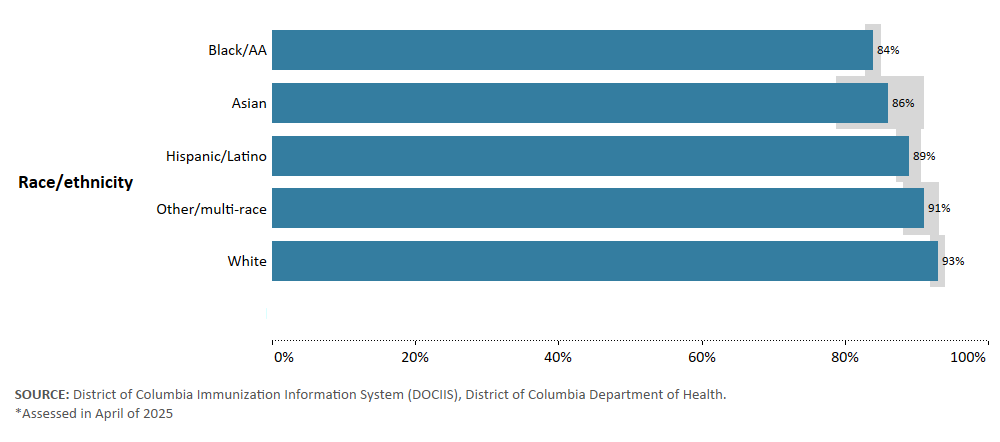
Among children in kindergarten, coverage with two doses of the MMR vaccine was highest (93%-94%) in public and public charter schools and significantly lower in parochial and private schools (81%-84%). The lower rates in parochial and private factors have several possible explanations. Children in these schools may not reside in the District of Columbia or may be vaccinated by health care providers outside of the District of Columbia, so their immunization records may not be reported to the DOCIIS database. Alternatively, the lower rates could reflect less strict enforcement of immunization requirements in these schools, which would raise concerns about the risks of disease outbreaks in those schools.
Immunization Coverage in Young Children Remains High
Experts recommend that children receive a primary series of vaccines during the first 18 months of life. This series includes a first dose of the hepatitis B vaccine immediately after birth and subsequent vaccines at 2, 4, 6, and 12-18 months of age against: measles, mumps, and rubella (MMR); diphtheria, tetanus, and pertussis (DTP); polio; varicella; and Haemophilus influenza type b (Hib). Children who are delayed in completing this primary series may be vulnerable to infections from these viruses and bacteria.
The most recent data available on the immunization coverage of toddlers come from the National Immunization Survey for children born in 2021, which reports vaccination of children up to their 2nd birthday in 2023. According to this survey, 77% of District children born in 2021 received their first dose of the hepatitis B vaccine by the second day of life, a percentage that has been increasing gradually in parallel with increases in the U.S. overall. 
Of this same group, 88% had received the first dose of the MMR vaccine by 13 months of age, similar to the nation as a whole. According to standard recommendations, children should complete their primary series of vaccinations with the vaccines given at 18 months of age. The standard population-based measure of immunization coverage of toddlers is completion of this series by 24 months of age. Of toddlers born in 2021, 74% were covered with the entire primary series of vaccines by 24 months of age, which was at or slightly above the national average. 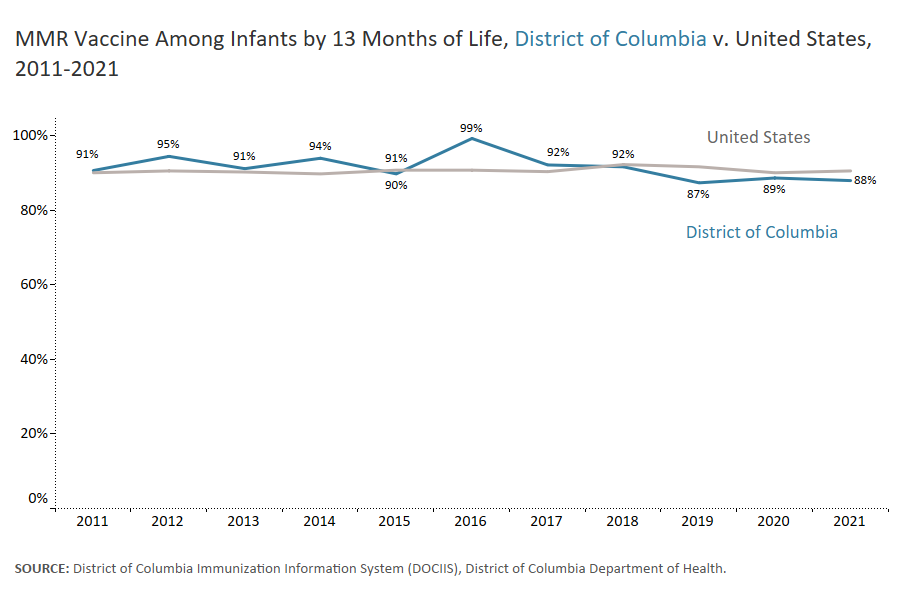

Overall, infants and school-aged children in the District of Columbia are well-protected against vaccine-preventable diseases. This protection is a result of adequate access to vaccinations in the District, recent improvements in data systems and the enforcement of school vaccination requirements. However, some children are still delayed in receiving their vaccines. Furthermore, all children are unprotected in the months before vaccines are recommended, which leaves some children at risk if outbreaks of these diseases were to occur in the District.
Despite the proven benefits and safety of vaccines, recent publicity about perceived risks of vaccines may prompt some parents to delay the vaccination of their children. DC Health will continue to promote childhood vaccination and to monitor vaccination coverage closely.
What Can Be Done:
DC Health will:
- Maintain a recommended vaccination schedule and school vaccination requirements that follow the guidance of scientifically-qualified experts.
- Continue to improve its data systems to better reflect the immunization status of District children.
- Work with education partners and school administrators to remain aware of the immunization status of school children so that they can enforce school vaccination requirements.
- Work with pediatricians and other primary care providers to promote the timely administration of vaccinations for children.
- Provide information to parents and the general public about the safety of vaccines and the importance of immunization coverage.
- Supply vaccines to health care providers through the federal Vaccines for Children program.
Policymakers can:
- Base immunization policies, including school attendance requirements and health professionals scope of practice, on standards from organizations of scientifically-qualified experts.
- Increase financial support for primary medical care and incentives to provide easy access to primary care, including vaccinations for children.
- Provide local financial support to further expand and improve the data linkages of the District of Columbia Immunization Information System, to assist health care providers who administer vaccines, and to promote vaccinations to parents.
- Strengthen the enforcement of school vaccination requirements.
Healthcare systems and providers can:
- Offer easy access to vaccinations, especially for infants and young children.
- Establish and use systems to identify children who are due and remind parents to bring them in to be vaccinated.
- Talk with parents about the importance and safety of vaccines.
School administrators and childcare providers can:
- Remind parents about school and childcare vaccination requirements and enforce them.
- Provide information to parents about where and how their children can be vaccinated.
Parents can:
- Bring infants and children to health care providers to be vaccinated according the experts’ recommended schedule.
- Discuss any concerns about the safety of vaccines with health care providers.