


ThruLines is a DC Health data brief series designed to inform the public about ongoing public health challenges. The series aims to take insights gleaned from analysis of local data to inspire evidence-based policies and programs that improve health in the District.
Confronting Lung Cancer in the District of Columbia
Despite declining smoking rates, lung cancer continues to rank among the most common cancers in the District. High incidence rates highlight ongoing challenges in prevention, early detection, and equitable access to care [1,2]. Screening with low-dose computed tomography (LDCT) enables early detection, improving survival and reducing mortality [3]. Continued reductions in smoking and expanded equitable access to screening remain critical to reducing lung cancer deaths in the District.
This Thru Lines examines lung cancer incidence, screening, stage at diagnosis and survival, and adult smoking rates using data from the District of Columbia Cancer Registry (DCCR) and DC Behavioral Risk Factor Surveillance System (BRFSS).
DATA SOURCES
The District of Columbia Cancer Registry (DCCR) is a population-based cancer surveillance system maintained by the DC Department of Health. DCCR collects cancer data from a wide range of sources, including hospitals, pathology labs, physician offices, nursing homes, hospice agencies, autopsy reports, and death certificates. Age-adjusted incidence rates were calculated and standardized to the 2000 U.S. population using data from 2013–2022 to ensure robust estimates and inclusion of the most recent years. Trends were assessed for 2006–2022 to capture long-term patterns, while stage at diagnosis and survival were evaluated for 2018–2022 to account for changes in summary staging implemented in 2018.
The District of Columbia Behavioral Risk Factor Surveillance System (DC BRFSS) is a national telephone survey conducted by the Centers for Disease Control and Prevention (CDC) in coordination with the states. BRFSS collects data from residents on self-reported health-related risk behaviors, chronic health conditions, health-care access, and use of preventive services. Lung cancer screening data used were from 2022 and 2024.
Declining together: Smoking prevalence and lung cancer incidence trends in the District
The prevalence of adult smoking in the District has declined significantly from 17.9% in 2006 to 9.8% in 2023, mirroring national trends. During the same period, the District also experienced a significant 2.7% (95% CI: -3.4 to -2.0) annual decrease in lung cancer incidence. This decline in lung cancer incidence in the District exceeds the 1.7% (95% CI: –1.9 to –1.5) decrease seen nationally.
Given that smoking is the primary risk factor for lung cancer [4], sustained reductions in tobacco use likely contributed to this trend. These findings emphasize the long-term effectiveness of the District’s smoking prevention policies and programs [5].

Black/AA residents have higher smoking rates and higher lung cancer incidence
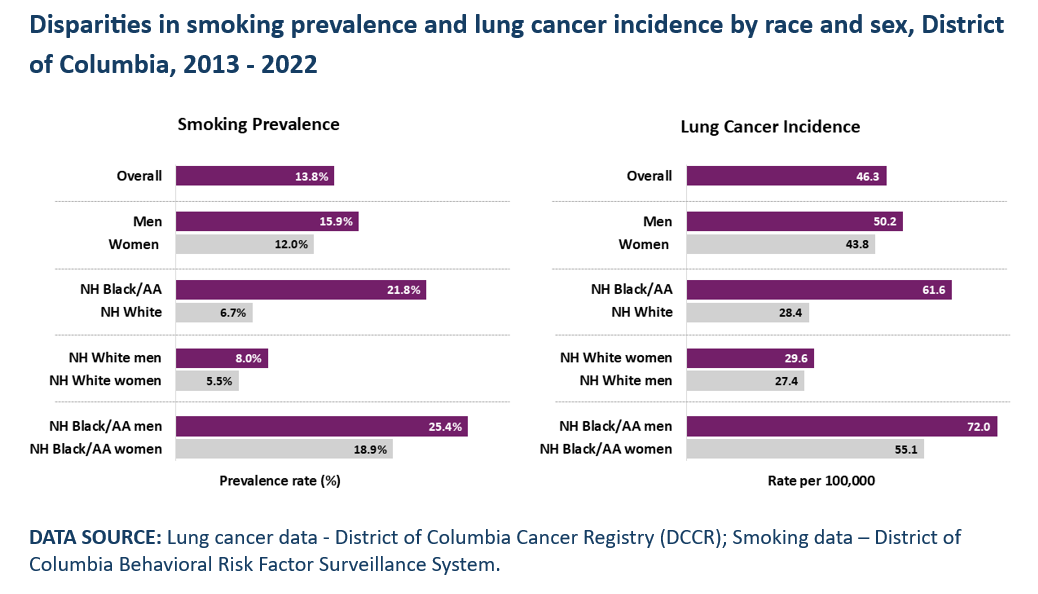
Between 2013 and 2022, the District’s age-adjusted lung cancer incidence rate was 46.3 per 100,000, significantly lower than the national average of 55.6. Between 2013 and 2022, rates of smoking were disproportionately higher among men and non-Hispanic (NH) Black/African American (AA) residents, with NH Black/AA men smoking at almost the double the citywide rate. This pattern aligns with elevated lung cancer incidence rates in these populations. District men experienced greater lung cancer incidence rates than women across all racial groups. Incidence rates were higher among NH Black/AA residents compared to NH White residents, with the highest rates observed among NH Black/AA men.
District Wards 7 and 8 are high-rate zones of smoking and lung cancer
Between 2013 and 2022, Wards 7 and 8 consistently recorded the highest smoking rates and the highest lung cancer incidence rates.

Early diagnosis is associated with improved survival
In the District, only 28% of lung cancer cases are diagnosed at an early stage (localized) - a proportion slightly above the national estimates. Residents with early-stage tumors have a much higher five-year survival rate (63.7%) than those with distant-stage tumors (13.8%). Overall, five-year survival across all stages in the District remains higher than national averages.

The District has made progress in lung cancer screening
The United States Preventive Services Task Force (USPSTF) recommends annual low-dose CT (LDCT) screening for adults aged 50 to 80 who have a smoking history of 20 or more pack-years and who either currently smoke or quit within the past 15 years.
In 2021, these guidelines were expanded from the previous criteria of ages 55 to 80 and a 30-pack-year history. Screening is not recommended for those who quit smoking 15 or more years earlier [6]. In 2024, 29% of current smokers in the District were eligible for screening.

Lung cancer screening in the District has made remarkable progress rising from negligible levels in 2022 to 24.4% in 2024 – surpassing the national average and moving the District to 4th in the nation [7]. DC Health helped drive this improvement by partnering with the Cancer Coalition, American Cancer Society, Medstar Washington Hospital Center, and local health systems to expand outreach, train clinical staff, and strengthen electronic medical records to better identify and refer eligible patients. The agency will soon collaborate with The American Lung Association to further increase access to LDCT for uninsured and underinsured residents and connect them with supportive resources.

Lung cancer remains one of the leading causes of cancer in the District. Declining smoking rates are likely associated with reduced lung cancer incidence. However, longstanding disparities in smoking rates across different populations in the District appear to be what is driving similarly disproportionate rates of lung cancer incidence. Although lung cancer screening rates among high-risk populations in the District are rising and exceed national levels, early-stage detection remains suboptimal. These findings underscore the need for the District to reduce smoking and other forms of tobacco use, and increase outreach and equitable access to screening, timely diagnosis, and treatment of lung cancer.
What Can Be Done:
DC Health will:
- Expand lung cancer screening access by partnering with clinics and hospitals to offer LDCT screening and prioritize high-risk populations.
- Increase screening referrals by training healthcare professionals on screening guidelines and integrating screening conversations into routine care.
- Support health systems to enhance electronic health records to systematically collect comprehensive smoking history so that eligible smokers are offered screening and help quitting, including services offered by DCQuitNow.
- Disseminate health communication campaigns to promote DCQuitNow and encourage quitting.
- Reduce secondhand smoke exposure by enforcing smoke-free policies in public spaces and workplaces and promoting smoke-free homes.
Policymakers should:
- Strengthen enforcement of tobacco control laws and expand protections, including smoke-free multi-unit housing, increased licensing fees, and ongoing monitoring of tobacco use and sales.
- Reduce tobacco use by prohibiting product discounting and requiring point-of-sale warnings to discourage purchases.
- Ensure coverage without prior authorization requirements of annual lung cancer screenings under Medicaid, Medicare, and private health insurance for individuals for whom screenings are recommended under USPSTF guidelines, mirroring the proposed federal Increasing Access to Lung Cancer Screening Act(H.R. 6178).
- Ensure policies are in place that remove cost barriers, for follow-up lung cancer diagnostic tests such as high out-of-pocket costs for imaging, limited insurance coverage, and indirect expenses such as transportation and time off work.
Health care systems and providers should:
- Establish tobacco and lung cancer screening policies and protocols within the health system.
- Integrate comprehensive tobacco screening into routine care to identify high-risk patients and refer for low-dose CT screening.
- Strengthen electronic health records to ensure accurate and comprehensive documentation of tobacco use and identify patients eligible for lung cancer screening and cessation services, including DCQuitNow.
- Screen for tobacco use at every visit and provide counseling and cessation support, including DCQuitNow.
- Inform patients about lung cancer risks and benefits of screening and promote smoke-free environments.
- Monitor patients who undergo screening for timely follow-up and coordinate care with specialists when screening shows abnormal findings.
- Train providers on lung cancer screening guidelines.
Health plans should:
- Provide financial incentives, such as value-based payments for providers who deliver smoking cessation counseling and screen high-risk patients for lung cancer.
- Cover comprehensive tobacco cessation services including counseling, medications, and Quitline support with no cost-sharing for members.
- Include Low-Dose CT (LDCT) screening for eligible high-risk patients under preventive care benefits.
- Ensure coverage of lung cancer screening follow-up diagnostic tests with no cost sharing for patients.
Community-based organizations should:
- Promote smoking cessation.
- Refer community members to counseling and Quitline services, including DCQuitNow.
- Implement comprehensive smoke-free campus policies.
- Collaborate with the DC Cancer Coalition and DC Tobacco Free Coalition.
- Educate community members and refer high-risk individuals for lung cancer screening.
Residents can:
- Quit smoking and other forms of tobacco use. If help is needed, seek tobacco cessation counseling and use Quitline services, including DCQuitNow.
- Maintain smoke-free homes and vehicles to protect family and visitors.
- Learn about lung cancer risks and screening eligibility.
- Talk to your doctor about LDCT screening if you are at high risk based on your age and smoking history.
References
- Shehata DG, Pan JM, Pan Z, Vigneswaran J, et al. Equity and Opportunities in Lung Cancer Care-Addressing Disparities, Challenges, and Pathways Forward. Cancers (Basel). 2025 Apr;17(8):1347.
- Brock BA, Mir H, Flenaugh EL, Oprea-Ilies G, et al. Social and Biological Determinants in Lung Cancer Disparity. Cancers (Basel). 2024 Jan;16(3):612.
- Nam B, Hamm D, Katurakes N, Mulligan C. Lung Cancer Screening: Early Detection Decreases Mortality. Dela J Public Health. 2024 Aug 28;10(3):22-24.
- Walser T, Cui X, Yanagawa J, Lee JM, Heinrich E, Lee G, Sharma S, Dubinett SM. Smoking and lung cancer: the role of inflammation. Proc Am Thorac Soc. 2008 Dec 1;5(8):811-5.
- Smoking cessation programs (DC Health). Available at https://dchealth.dc.gov/service/smoking-cessation-programs; [Accessed on 2026 January 7].
- U.S. Preventive Services Task Force: Final Recommendation Statement – Lung Cancer Screening: 2021 March. Available at: https://www.uspreventiveservicestaskforce.org/uspstf/recommendation/lung-cancer-screening [Accessed on 2025 November 7].
- State of Lung Cancer 2023 & 2024 report. American Lung Association [Accessed on 2025 November 7].